OTTER CREEK FOUNDATION CAUSES AND PROJECTS

Otter Creek Foundation is an organization dedicated to protecting our environment from invasive and non-native species. We are supporting the Feral Hog Contraception Project where we work with Dakota Research Labs to implement their oral Immunocontraception vaccines to stop the rampant breeding of feral hogs. We are focused on helping Dakota Research in finding and testing an oral vaccine for the horrible disease Brucellosis which affects wild animals, domestic animals and can be transmitted to humans, We are also focused on other invasive species like pythons, iguanas, and monitor lizards. Of great pride to us is the addition of research and testing efforts to support feral cat and free roaming dog Trap-Neuter-Release (TNR) population control and pathogen defense programs. Lastly, we are hoping to get approval to study and monitor the Endangered Lower Keys Marsh Rabbit, found only in the Key West area.
Please review our efforts below. If you wish to support our efforts, please check out our Donation and Adoption pages.
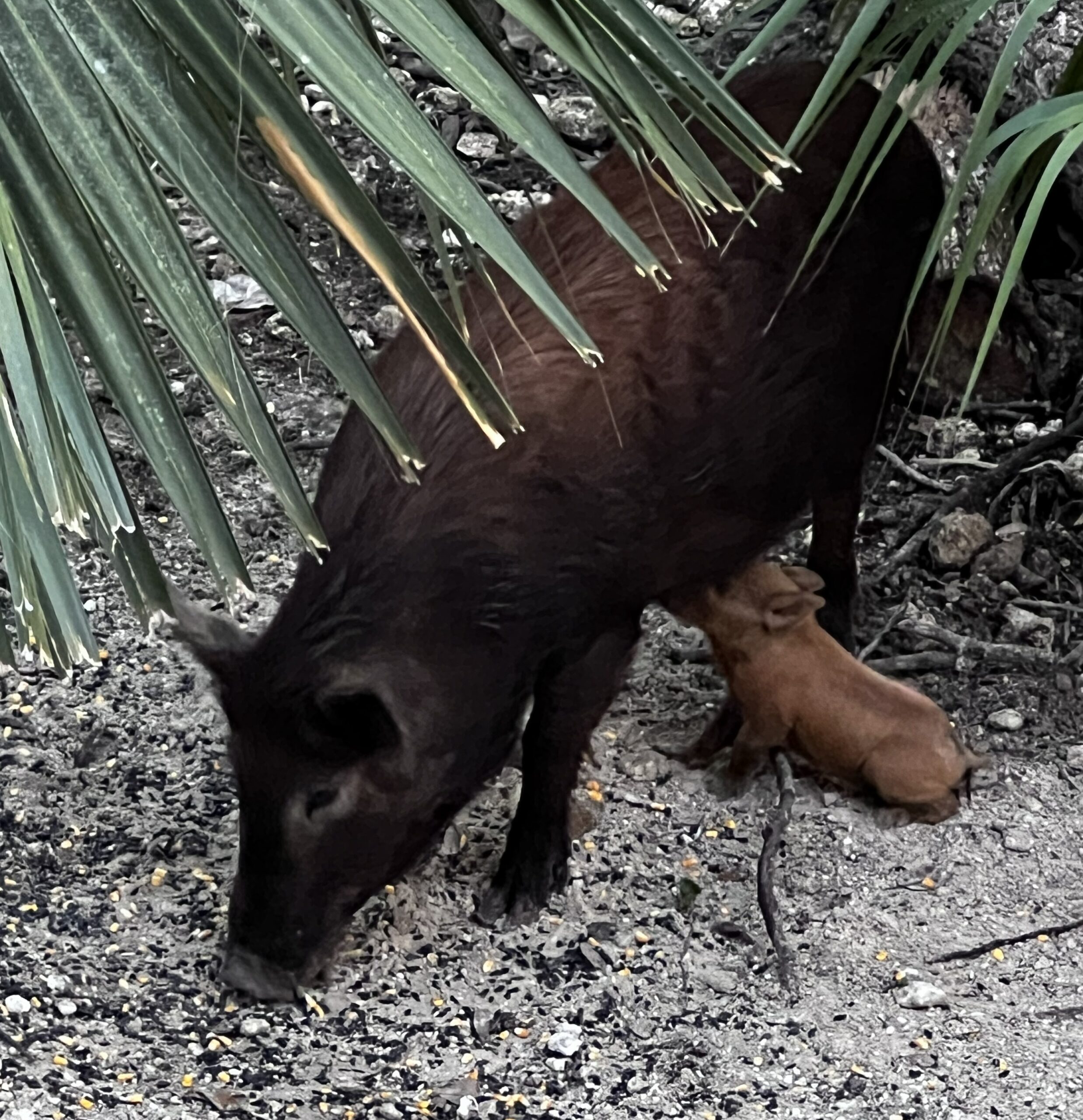
Do you know that every 6 months a female feral hog can have a new litter of 6-9 piglets. These piglets become breeding age at as young as 6 months! There are few natural predators and current human efforts to control the population explosion are not working. That leads to over $3.5 BILLION in damages and environmental destruction.
Read about our projects below
Our primary project today is supporting the Dakota Research Labs in the continued development, testing, permitting and employment of an oral contraception vaccine for both male and female feral hogs.
Feral hogs can breed at the early age of 6 months and a single female can have two litters of 6 to 9 piglets a year! With few natural predators, even human control measures such as trapping, barbaric field castrations, and hunting cannot keep up with the exponential population growth.
That is why our Founders are developing oral contraceptives. Their solution does not kill the pigs, just permanently sterilizes them, painlessly and without side effects. This will result in an exponential reduction of the pig population to manageable levels through natural and man-made causes.
This effort is expensive, but well worth it to overcome the $3.5 Billion in damages currently caused by the Feral Hog population explosion. Check our FERAL HOG PROJECT page to see the latest status.
Some of the requirements we address through donations and adoption funds:
Vaccine Delivery Equipment & Feeders – feeders are essential to delivering the medicated food products safely and without impact to the surrounding environment and animals. Pigs are smart and destructive. They learn how to dismantle the feeders to access the feed. We have to replace our feeders at least yearly. We need six new feeders @ $400 per feeder.
Laboratory Equipment & Supplies – as a biogenetics lab, our consumables and supplies are very expensive, but the end result is a solution that saves the world.
Medicine & Antibiotics – Feral hogs contract many diseases and suffer from numerous cuts and scrapes. Although their immune system is rather remarkable, we provide oral medications, antibiotics, and vitamins to help our “research partners” be as healthy as possible to ensure the best environment for our vaccine solutions.
Pig Food – food is essential to the delivery of our oral vaccine for contraception. We average $800 – $1000 per month for feed.
BSL1/BSL2 Test Facilities – The testing of the vaccines for permitting by the USDA-APHIS and the EPA must be accomplished through laboratory and live animal testing. We support no kill animal testing only. This requires Dakota Research Labs to contract for a Biological Safety Level (BSL) 1 or 2 facility. This is a facility that segregates the test subjects and maintain strict control and protocols that work to ensure secure and predictable results. This is extremely expensive. Dakota Research Labs will be contracting us to help with the data collection, auditing and reporting of the results. If we get the funding, we could fund the entire testing process which puts the benefits of the tests readily available for the public and other research facilities per our charter as a public benefit charity.
Swine brucellosis is an infectious disease caused by the bacteria Brucella suis (B. suis). It produces chronic inflammatory lesions in the reproductive organs that lead to abortions, infertility, and birth of weak piglets. The disease can also attack joints, leading to lameness.
The United States eliminated the disease from commercial swine in 2011. However, swine brucellosis is still present in wild swine in this country. Any mammal exposed to feral swine are at risk of infection. And yes, Swine Brucellosis can also infect people.
During their research into an effective contraception for feral hogs, our Founders asked themselves if their research could also address the brucellosis problem. Nearly all of our ”research partners” (our pig family), showed signs of brucellosis, with many suffering greatly or succumbing to the disease completely. Because the oral vaccine is similar to the oral vaccines used for COVID-19 and other newer generation treatments, it was not a stretch to use the immunologic capability of this new design to attack brucellosis. This vaccine, if successful, will be able to be used across all wild and domestic animals as a preventive vaccine.
Check our FERAL HOG BRUCELLOSIS ORAL VACCINE PROJECT page to see the latest status.
Vaccine Testing and Data Collection – Using similar tools currently employed to design and create vaccines for the Flu and COVID, we will be tasked to refine and test this solution. This is a precise process with key controls and steps required for validation and approval by State and Federal Agencies. The testing and permitting process is expensive, and funds are needed to allow for contracting out the live animal testing and any resulting redesign and retesting as required by the reviewers. Development for commercial delivery and sales will most likely be best contracted out to third party laboratories that specialize in this area. We need help with your donations to develop, test, permit and prepare for commercial deployment.
Otter Creek Foundation is expanding into the humane management of feral and free-roaming cat and dog populations, working alongside Dakota Research Labs and NoraSuto to test and deploy oral contraception and pathogen defense technology built to support — not replace — the Trap-Neuter-Return (TNR) efforts already underway in communities everywhere. Our role is to serve as an independent testing and field deployment partner, carrying this work from the lab into real-world use so that donor support goes directly toward getting a safe, effective solution into the field.
Funding Required to Begin – The primary focus of our funding will be on in vitro (laboratory) testing and humane in vivo (live animal) testing. This is required for permitting and approval for commercial production. The faster this testing is completed, the faster these solutions are made available to current and future TNR programs.
Check our Feral Cat & Free Roaming Dog TNR page for more information and to see our latest status.
The Lower Keys Marsh Rabbit was federally recognized as an “endangered species” on June 21, 1990. It is affected by destruction to its habitat. The urbanized Florida Keys have left the rabbit with a very small home range, making it more vulnerable to threats such as pollution, vehicular road kill, and predation by stray cats. In 1995, scientists predicted a gradual decline in the rabbits abundance and extinction by 2045. The Lower Keys marsh rabbit population is estimated to contain approximately 150 individuals.
The largest population of Endangered Lower Keys Marsh Rabbits resides on the US Naval Base on Boca Chica Key near Key West, Florida. Our Key West Team are proposing to perform data collection on the numbers and location of these tiny rabbits. The effort will occur mostly at night when the rabbits are most active and Naval Flight Operations are limited. This data collection will support research performed decades earlier and may help determine if conservation efforts are helping or if further actions are required. Our Key West Team is made up of active duty and retired military and US Government Civilians which allows for unhindered base access. Our relationship with the Base Leadership and experience within the base infrastructure should assist in a smooth and transparent integration within the base activities.
Funding Required to Begin – Although this is a short project and the effort will mostly be conducted by volunteers, we need funding to provide lodging, food, transportation and appropriate clothing for the teams. Additionally, we need to provide night vision cameras and if allowed, a drone capable of IR and night vision photography. This equipment will see benefit across the other projects as we are tasked to conduct research and data collection for each additional effort.
Check our Lower Keys Marsh Rabbit Research page for more information and to see our latest status.
Not really a Cause, but the Dakota Research Labs Field Laboratory completion and equipment setup is critical to all of the projects. Dakota Research Labs has contracted with us to help complete the build and installation of the Field Lab with in house staff and funding. In return we get to use the lab free of charge. The Founders original LLC maintains ownership of over $500,000 worth of new and used equipment. Much of this equipment requires some level of repair or maintenance to be fully operational. As we progress through the projects, we will need to bring more of this shared vital equipment online. The high-value equipment, such as gene sequencers, DNA synthesizers, and sample analysis tools, require a considerable investment in supplies and consumables such as chemicals and reagents. These costs are planned for the future by Dakota Research Labs when they seek investors for seed funding. Because their use in-house will considerably offset the external costs to develop and implement our testing and data collection, we are eager to help Dakota Research Labs to implement this equipment as soon as practical. Dakota Research Labs currently relies on third party vendors to provide the components they need to create the designed vaccines and perform laboratory testing and evaluation of efficacy. Once we as a collective can enable the equipment in the lab, we will cut the overall project costs by at least 60%. This translates to more funds for live animal testing and efforts to support permitting and licensing. This means a faster time to market and a quicker time to the field where these products are needed.
Some of the requirements we hope to address through your donations of equipment and funds:
Ultra Low Temperature Freezer Maintenance and Repair – Ultra Low Temperature freezers reach cold temperatures up to -80C. This is necessary to freeze and protect the DNA fragments and final vaccine products to be tested and designed. The annual maintenance of the lab’s two freezers will exceed $800. A coolant recharge and component repair is needed for the primary freezer at a cost of $1,400.
Laboratory Equipment Calibration – Lab equipment is required to be accurate to levels that necessitates frequent testing and calibration. Weigh scales and balances, pipettors, incubators, chillers, protein and DNA synthesizers, DNA sequencers, biosafety hoods and personal protective equipment all need routine maintenance and calibration. A certified technician is usually required to perform the calibration to maintain required standards. The annual costs for calibration and maintenance will exceed $1,500.
Laboratory Consumables & Chemicals – To maintain clean and sterile environments and practices, laboratory consumables such as flasks, tubes, bottles, petri dishes, pipette tips, weigh scale boats, reagents, growing material, etc., are not reused under best practices. This results in a need for significant amount of consumables and supplies on a routine basis. Also, specific consumables kits are required for the gene sequencers or synthesizers. The annual expectation of consumable costs will exceed $10,000.
Laboratory Computers and Software – We are currently configuring donated and used computer equipment to set up the data server and software host Dakota Research Labs needs to network and run the lab’s equipment. However, the biggest expense will be the large amount of data storage required for gene sequencing. Although digital storage is getting less expensive, we are still expecting to pay in excess of $4,000 to get our network and servers up and running. One of the most critical needs right now is a comprehensive Laboratory Management System. This software is key to perform and manage laboratory supplies and equipment inventory and usage, manage individual projects through specific protocols required for validation and certification, support budget management, integrate with staffing and project management applications, prepare for and complete audit requirements, and develop real time dashboards and scheduled reports. After a lengthy assessment, the Lab Management System we selected will cost $2,500 per year. We hope to get enough donations to support our subscription for three years or more. Our total need for this requirement is in excess of $12,000.
A Board Management Portal is a critical part of our organizational health and security. As a nonprofit, we are not owned by any Founder or Shareholder. We are a public entity, completely owned by the public trust. This means that our Board of Directors are nothing more than the governance structure to keep this organization headed in the right direction and being good stewards of the money provided to us through donations and grants. A nonprofit is guided by a strict set of rules and regulations and deviating from them could result in the dissolution of the organization and its mission. To better govern and manage the leadership of the organization, many of the most effective nonprofits use a Board Management Portal, which is a complex software application that provides a lot of experience, knowledge and structure into a regulatory framework that ensures success. A Board Management Portal handles the every day capturing of documents and artifacts of each Board Committee and the goals of the organization as established in the Bylaws set forth by the Board of Directors. The tool is indispensable in scheduling meetings, allowing for voting and signatures on key documents, capturing initiatives and project approvals, documenting funding strategies and purchases, and setting aside all artifacts for auditing and control by independent agencies and organizations. These tools are not cheap. A typical Board Management Portal costs about $6,000 a year. But the cost is well justified, especially if the management of the public’s trust and funds are secure, controlled, and made readily available to the public per legislation and regulatory policy.
Pythons have found a perfect habitat in the Everglades and South Florida. They are decimating the native small mammal population and are crowding out native reptiles. These animals have no natural predators for control and are growing well beyond the ability of the ecosystem to support them and our native species as well. Our efforts are to find a humane solution to effectively manage these invaders without the need for significant human interaction.
Florida Iguanas are not necessarily competing with other Florida reptiles, but they do carry reptilian diseases and are a nuisance. These animals have no natural predators for control and are growing well beyond the ability of the ecosystem to support them and our native species as well. Our efforts are to find a humane solution to effectively manage these invaders without the need for significant human interaction. Dakota Research Labs has licensed the oral vaccine that is species specific for Florida Iguana (Iguana iguana) and we will be contracted to perform the labor for field testing once permitting is approved.
Lionfish were released in the Florida Keys by an entrepreneur who thought he could create a natural source of a very good fish for his restaurant. Lionfish have crowded out native reef fish and are destroying the local ecosystem. These animals have few natural predators for control and are growing well beyond the ability of the ecosystem to support them alongside native species. Our efforts are to find a humane solution to effectively manage these invaders without the need for significant human interaction. Dakota Research Labs will contract us to support gene sequencing of invasive lionfish populations in the Florida Keys.