
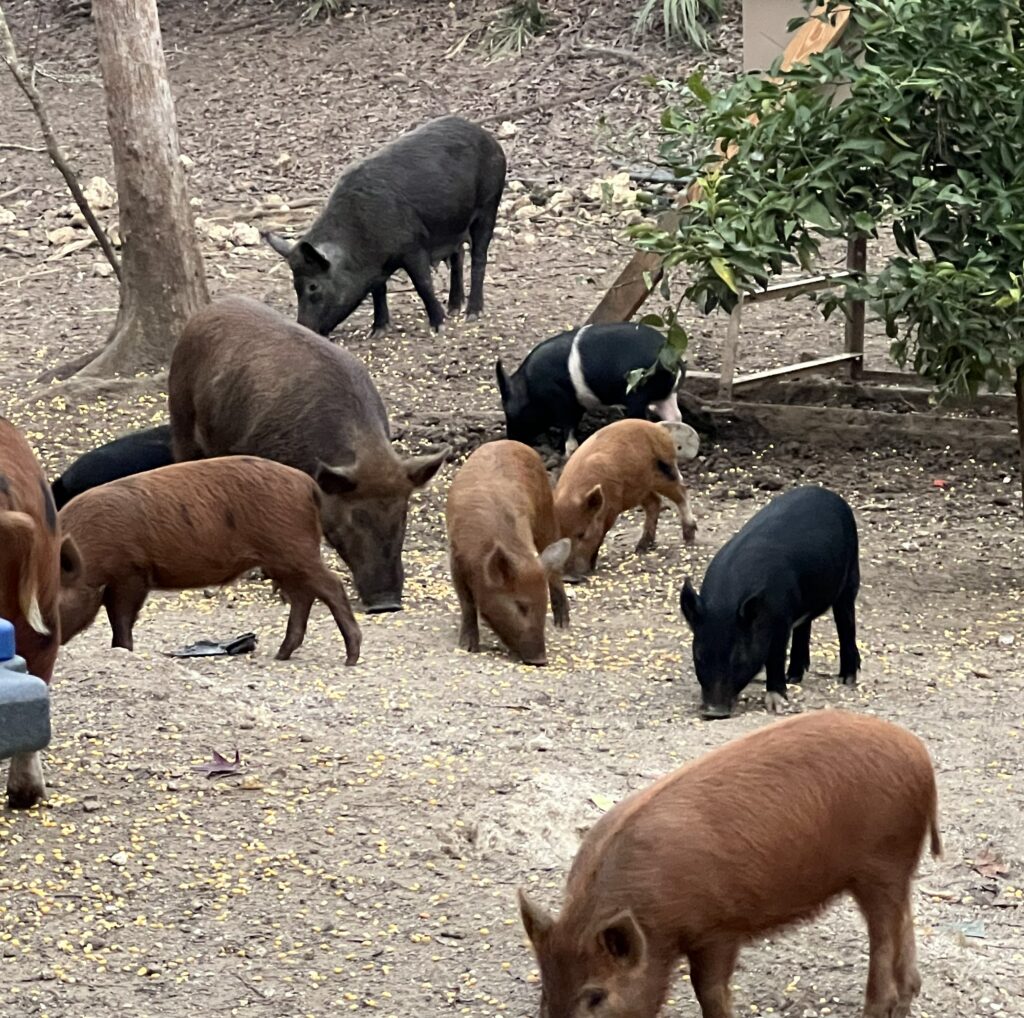
Our primary project today is supporting the Dakota Research Labs in the continued development, testing, permitting and employment of an oral contraception vaccine for both male and female feral hogs.
Feral hogs can breed at the early age of 6 months and a single female can have two litters of 6 to 9 piglets a year! With few natural predators, even human control measures such as trapping, barbaric field castrations, and hunting cannot keep up with the exponential population growth.
That is why our Founders and Dakota Research Labs are developing oral contraceptives. Their solution does not kill the pigs, just permanently sterilizes them, painlessly and without side effects. This will result in an exponential reduction of the pig population to manageable levels through natural and man-made causes.
This effort is expensive, but well worth it to overcome the $3.5 Billion in damages currently caused by the Feral Hog population explosion.
Some of the requirements we address through donations and adoption funds:
Vaccine Delivery Equipment & Feeders – feeders are essential to delivering the medicated food products safely and without impact to the surrounding environment and animals. Pigs are smart and destructive. They learn how to dismantle the feeders to access the feed. We have to replace our feeders at least yearly. We need a minimum of six new feeders @ $400 per feeder.
Laboratory Equipment & Supplies – as a biogenetics lab, our consumables and supplies are very expensive, but the end result is a solution that saves the world.
Medicine & Antibiotics – Feral hogs contract many diseases and suffer from numerous cuts and scrapes. Although their immune system is rather remarkable, we provide oral medications, antibiotics, and vitamins to help our four legged “research partners” be as healthy as possible to ensure the best environment for our vaccine solutions.
Pig Food – food is essential to the delivery of an oral vaccine for contraception and pathogen defense. We average $800 – $1000 per month for feed.
BSL1/BSL2 Test Facilities – The testing of the vaccines for permitting by the USDA-APHIS and the EPA must be accomplished through laboratory and live animal testing. We support no kill animal testing only. This requires Dakota Research Labs to contract for a Biological Safety Level (BSL) 1 or 2 facility. This is a facility that segregates the test subjects and maintain strict control and protocols that work to ensure secure and predictable results. This is extremely expensive. Dakota Research Labs will be contracting us to help with the selection and monitoring of vendors, data collection, auditing and reporting of the results. If we get the funding, we would want to fund the entire testing process which puts the benefits of the tests readily available for Dakota Research Labs permitting and regulatory requirements but also provides this data to the public and other research facilities per our charter as a public benefit charity.
Our Project Goals
We are seeking humane solutions for feral hog contraception. The primary issue with any vaccine for contraception is the delivery method. It is unreasonable to develop the typical injection type vaccine as the probability of finding cornering and injecting all of the feral hogs in an area is very low. The historically barbaric solution is to capture the males (boars) and to perform a field castration, without anesthesia, antibiotics or even clean equipment. Usually a hunter will use a dirty pocket knife. Then the pigs are let loose to suffer through the pain and trauma of healing and potential infection.
The most humane and potentially successful solution is through an oral vaccine delivery method. Our project seeks a multi-tiered vaccine that can be delivered in engineered baits or mixed in a matrix or with grain for feeding through timed feeders. The solution must be specific to the species targeted or easily controlled with minimal human intervention. This ensures non-target animals are not affected by the vaccine. Additionally the solution must not impact the local environment, domestic animals, or humans. This is accomplished through design or strict employment controls. This vaccine, if successful, will be able to be used across all wild and domestic animals as a preventive vaccine. Dakota Research Labs has developed four different oral delivery vectors which can be used alone or combined for a more effective and long lasting result.
Current Status
As of 01 AUG 2026, our Founder, Keith, submitted Provisional Patent applications for oral immunocontraception vaccines targeting feral hogs. These patents will be licensed to Dakota Research Labs for development and commercialization after permitting. This is a great breakthrough! We are eagerly awaiting the funding required to assist Dakota Research Labs to bring this product to market and support our goals for wildlife welfare and humane population control.
Risks to Pets and People
Feral swine are known to carry at least 30 viral and bacterial diseases and nearly 40 parasites that can be transmitted to humans, pets, livestock, and other wildlife.
The most common way pathogens and parasites are transmitted from feral swine to humans is through handling and butchering feral swine or eating meat that has not been cooked thoroughly. Gloves should always be worn when handling feral swine carcasses, and meat should always be cooked to a safe internal temperature of 160oF in order to kill the parasites and pathogens that the animal may be carrying. Harmful organisms and pathogens, carried by feral swine, which can infect humans include diseases such as leptospirosis, toxoplasmosis, brucellosis, tularemia, trichinellosis, swine influenza, salmonella, hepatitis and pathogenic E. coli. If you feel ill after coming into contact with or consuming feral swine meat, contact your physician or health department immediately.
Livestock, pets, and other domestic animals can also be susceptible to many pathogens carried by feral swine. These pathogens can be spread in many ways, such as through direct contact with feral swine or their scat, by using feeding and watering containers that have been contaminated by feral swine, or by eating raw, infected feral swine meat, organs, or other tissues. Watch for signs of illness (fever, lethargy, swelling in joints, respiratory, and reproductive problems) in your pets and contact your veterinarian immediately if signs of illness are observed. Caution should be taken around pets and livestock that are suspected to be ill from recent contact with feral swine since some diseases can be transmitted to other animals and possibly humans.
Other risks posed by feral swine to people include attacks on individuals or collisions with vehicles and aircraft. Feral swine have been aggressive towards and even attacked farmers, golfers, hikers, and picnickers. Aggression can be increased when they associate people with food because of handouts and improper waste disposal.
History of Feral Swine in the Americas
Feral swine are not native to the Americas. They were first brought to the United States in the 1500s by early explorers and settlers as a source of food. Free-range livestock management practices and escapes from enclosures led to the first establishment of feral swine populations within the United States. In the 1900s, the Eurasian or Russian wild boar was introduced into parts of the United States for the purpose of sport hunting. Today, feral swine are a combination of escaped domestic pigs, Eurasian wild boars, and hybrids of the two.
Project Timeline
The project timeline will be provided to Donors along with other exclusive material.
Project Donation Needs
- Donations greatly assist us in funding the activities required to complete the testing and permitting phases of this project.
- Donors will be provided a detailed report on the proposed actions and schedule, cost projections, bi-weekly status reports, test and evaluation results, and final completion report.
- Total Investment Goal: $200,000